
Wire size & ampacity
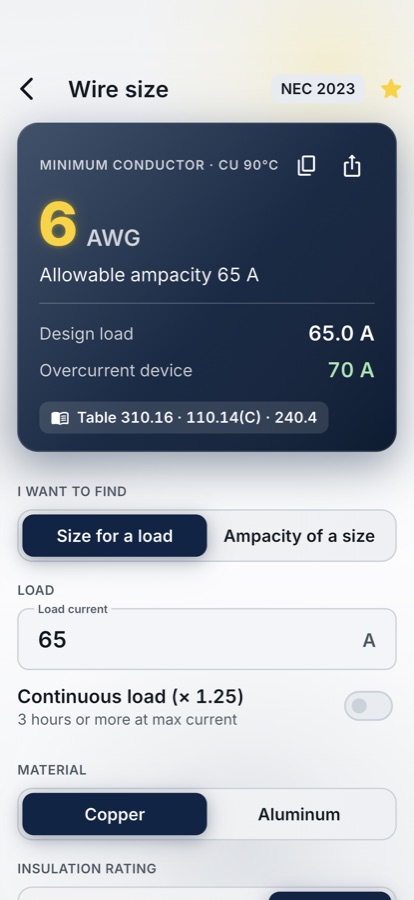
Table 310.16 with ambient correction, bundling adjustment, 110.14(C) termination limits, the 240.4(D) small-conductor rule and a breaker recommendation.
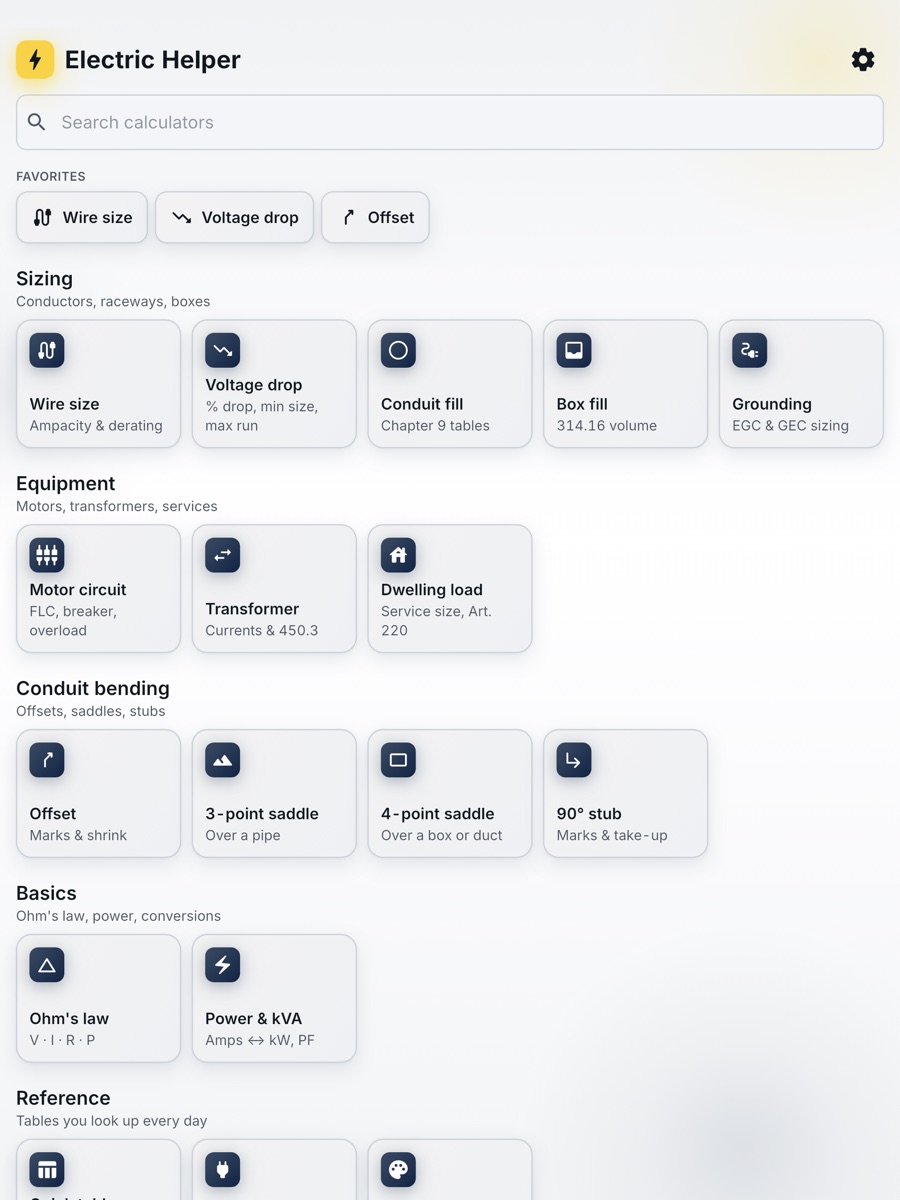
Thirty-nine calculators and references: wire size, voltage drop, conduit and box fill, fault current, EV chargers, generators, solar PV, dwelling and multifamily loads, motors, transformers, conduit bending and the wiring rules inspectors check. Every answer in big type, with the NEC table cited and the math laid out so you can defend it.
Thirty-nine calculators and references built from the NEC tables, cross-checked, and unit-tested against textbook and handbook examples.
Table 310.16 with ambient correction, bundling adjustment, 110.14(C) termination limits, the 240.4(D) small-conductor rule and a breaker recommendation.
DC, single-phase and three-phase, copper or aluminum, parallel sets, Table 8 resistance or Table 9 AC impedance with power factor. Find the drop, the minimum size, or the maximum run.
EMT, IMC, RMC, PVC 40/80, FMC, LFMC, LFNC and ENT with Chapter 9 Tables 1, 4, 5 and 8. Mixed sizes, bare grounds, nipples. Fill %, smallest conduit, or most conductors that fit.
314.16 volume counting for conductors, devices, clamps, fittings and grounding conductors with the smallest standard box that fits, plus 314.28 pull and junction box sizing for straight, angle and U pulls.
Full-load current from Tables 430.248 and 430.250, conductor sizing, Table 430.52 protection and overloads, multi-motor feeders per 430.24 and 430.62, and Table 450.3(B) transformer protection.
Standard and optional Article 220 methods, added loads in existing dwellings (220.83), the multifamily optional method (220.84), the 310.12 dwelling service-conductor rule, and the resulting service size. Share the step list with the inspector.
Offsets, rolling offsets, kicks, three- and four-point saddles, 90° stubs, back-to-back and segmented 90s, with numbered marks measured from the end of the pipe, shrink and bender take-up.
Does the charger fit the existing service? 220.87 metered demand, 220.57 EVSE load and the 625.42 energy-management setpoint. Standby generator sizing per 702.4 and 445.13. Solar PV conductors and fuses per 690.8 and 690.9, inverter output and the 705.12 busbar rule.
Point-to-point available fault current from transformer kVA and impedance or a known value, through each conductor run, for the 110.24 label. Parallel conductor sets per 310.10(G) with the equipment grounding conductor for each raceway.
Receptacle spacing per 210.52 with suggested positions, a GFCI and AFCI checklist that follows your code edition, Table 300.5 burial depth, conduit and cable support spacing, and Annex I torque values.
Ohm's law, power and kVA, power-factor correction with capacitor kVAR, series and parallel resistance, conductor resistance at any temperature, and a unit converter with AWG to mm², hp to kW and torque.
Ampacity tables, AWG to mm² and resistance, standard breaker sizes, bend multipliers, NEMA plug and receptacle configurations, wire color codes for the US, Canada, IEC and UK.
Designed for gloves, sunlight and dim electrical rooms.
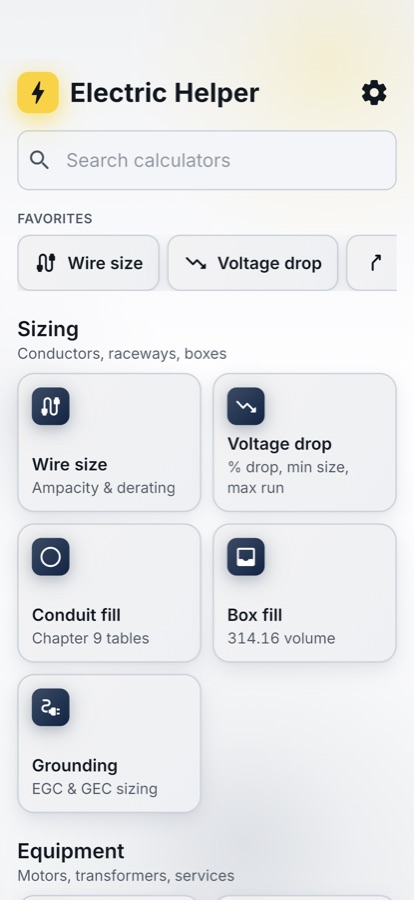
Every calculator one tap away
Wire size with the NEC table cited
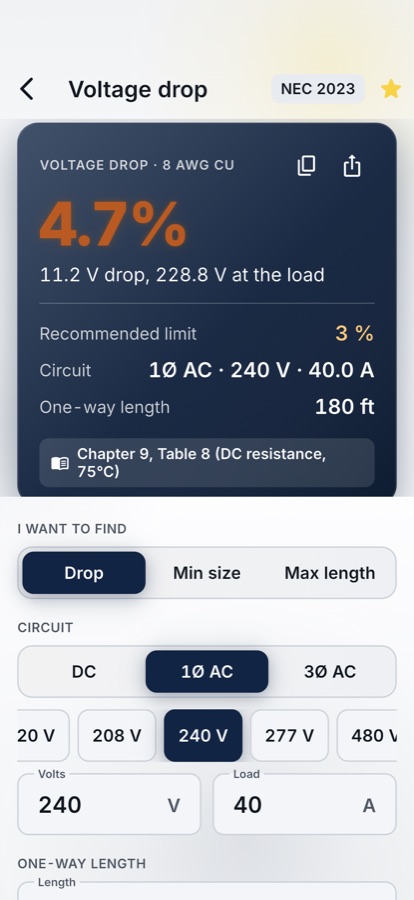
Voltage drop: %, minimum size or max run
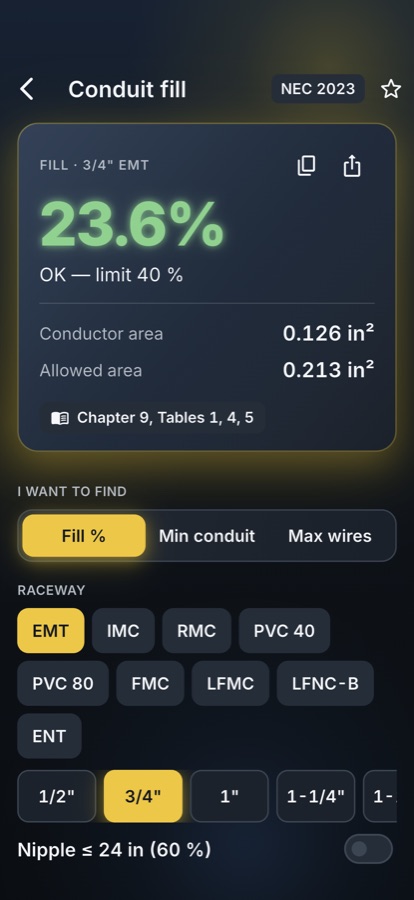
Conduit fill in dark mode
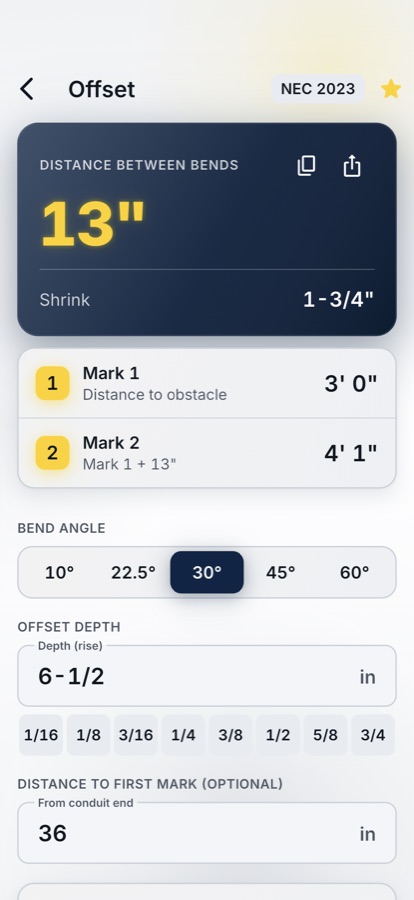
Bending marks from the end of the pipe
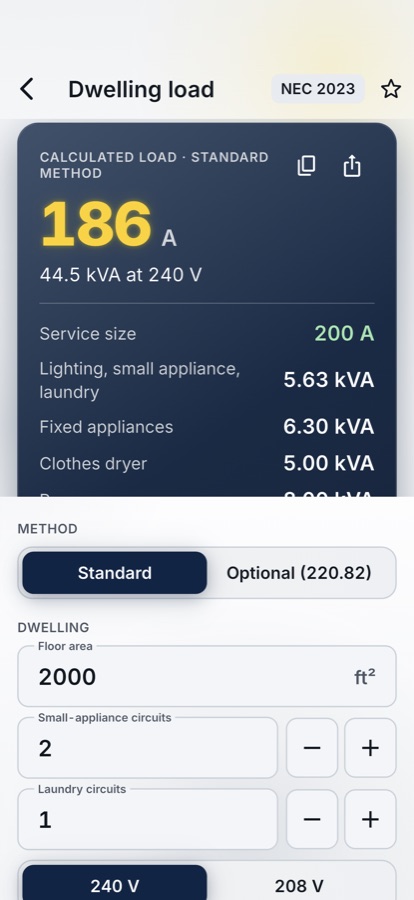
Dwelling load and service size
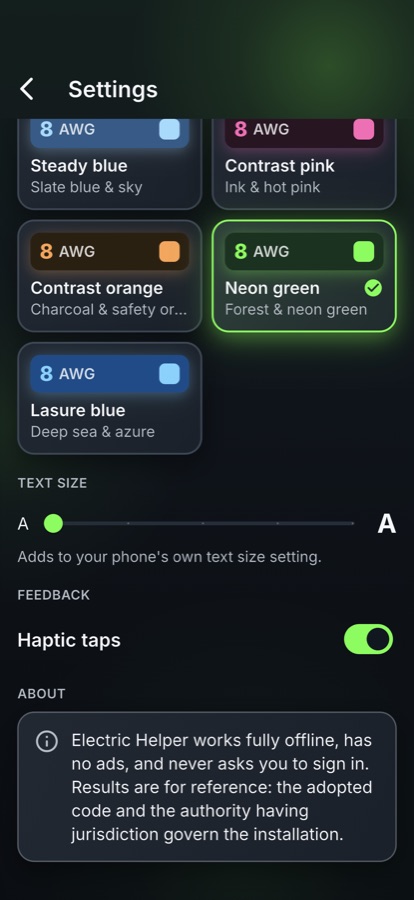
Seven color themes
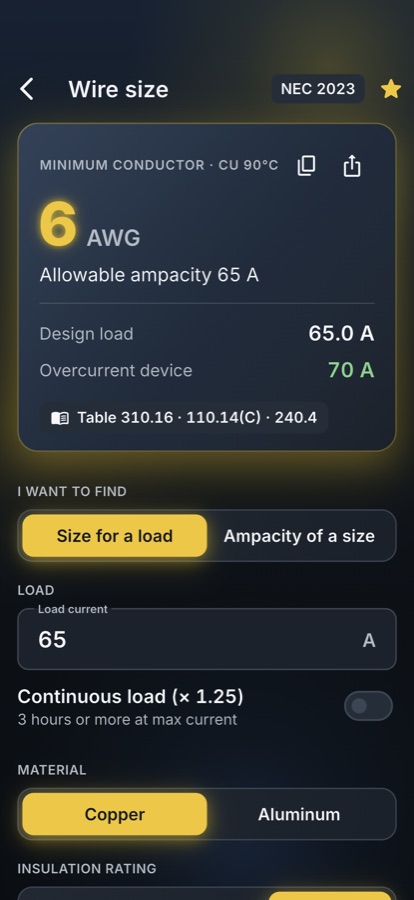
Large type built for the jobsite
No subscription for the math. No paying again for the next code edition.
NEC 2017, 2020, 2023 and 2026. Choose the edition your jurisdiction has adopted in Settings; all calculators follow it. New editions are added as free updates.
Yes. Every table and formula is on the device. Nothing requires an account or a connection, including Pro after it is unlocked.
No. The free tier is free forever. Pro is a single purchase of $12.99 that unlocks everything, on the App Store or Google Play, and restores on your other devices.
Every table value was cross-checked against two published sources, and every calculator has unit tests against textbook examples. Each result cites the NEC section and shows the intermediate steps so you can verify it. The adopted code and the authority having jurisdiction always govern the installation.
Yes. Enter the service rating and either the metered peak demand (220.87) or the calculated load, then the chargers. It reports the total against the service, and if it does not fit, the energy-management setpoint (625.42) that would make it fit.
Yes. The point-to-point method used by the industry: transformer kVA and impedance or a known value at the start, then each conductor run by size, material and length, giving the value for the 110.24 label.
Standby generator sizing from metered or calculated load with the 702.4 transfer rules and 445.13 conductors, and solar PV source-circuit conductors and fuses per 690.8 and 690.9, plus the 705.12 busbar rule for the inverter breaker.
Yes. Switch units in Settings: lengths in millimetres, AWG to mm² conversions, and the same calculators.
Yes. iPad and Android tablets get a wider layout with the same large type.